
Answer-First Summary
Quick answer
8 common construction mistakes Bengaluru homeowners make that cause wall cracks, leakages, and structural damage within 2 years. Engineer-reviewed prevention guide with cost-saving fixes.
- Why do new houses in Bangalore develop wall cracks within 2 years? Most wall cracks in new Bengaluru homes are caused by 8 specific construction errors: skipped soil testing, wrong concrete mix (M15 instead of M25), inadequate curing (under 14 days), unbranded cement, wrong steel grade (Fe415 instead of Fe550D), missing waterproofing in bathrooms and terraces, no expansion joints in long walls, and skipping structural engineer oversight. Bengaluru's expansive black cotton soil and bimodal monsoons accelerate these failures. Fixing them after handover costs 5-10x more than getting them right during construction.
- Is soil testing really necessary before construction in Bengaluru? Yes, absolutely. Bengaluru's soil varies dramatically by zone — rocky laterite in the east (Whitefield, Sarjapur), red loam in the south (Banashankari, Kanakapura Road), and expansive black cotton soil in the north (Devanahalli, KIAL belt, parts of Yelahanka). A standard Plate Load Test costs ₹8,000-15,000 and tells your structural engineer the Safe Bearing Capacity (SBC) of your plot. Skipping it can lead to differential foundation settlement, wall cracks, and ₹5-15 lakh retrofitting costs within 5 years.
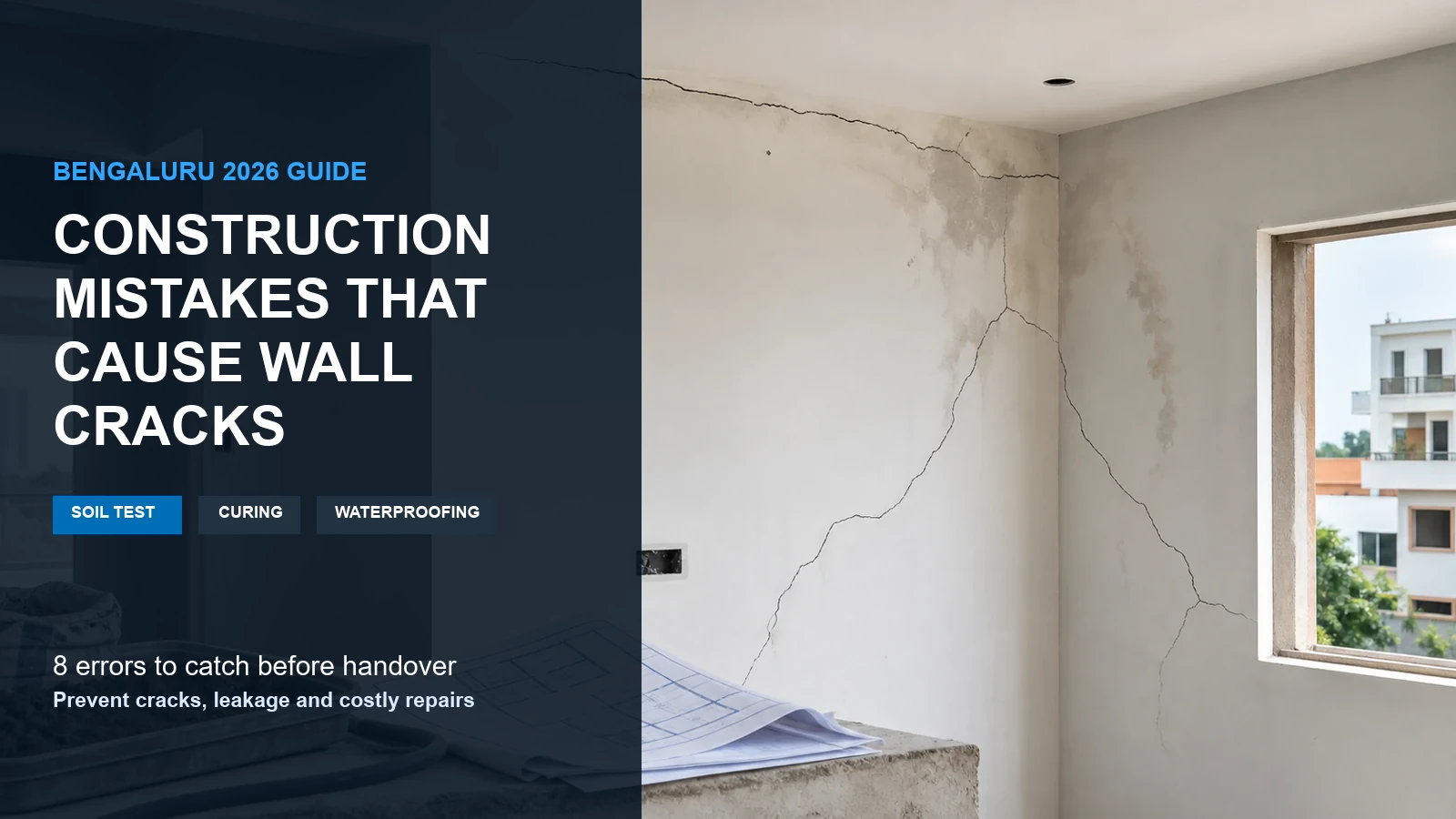
If you have noticed hairline cracks appearing on walls and ceilings in homes that are barely 18-24 months old, you are not alone. Bengaluru sees over 15,000 new independent homes built every year, and based on the site visits our engineering team has conducted, 3 out of 5 of those homes will develop visible cracks within 24 months of moving in.
Most of these cracks are not bad luck. They are not “settling.” They are the predictable result of 8 specific, repeatable mistakes that contractors in Bengaluru are still making in 2026 — even on projects that cost ₹60 lakhs and above.
In this engineer-reviewed guide, we walk through each of those 8 mistakes, what they cost to prevent, and what they cost to fix if you skip them. By the end, you will have a clear 8-point quality checklist to share with your contractor before you sign the agreement.
💡 Quick Reference: The 8 mistakes cost a combined ₹60,000-90,000 to prevent during construction. Fixing them post-handover costs ₹4-12 lakhs and never gives the same structural integrity. For a personalized cost breakdown of getting all 8 right on your Bengaluru plot, use our free AI House Construction Cost Calculator.
📖 Table of Contents
- • Why Bengaluru Homes Crack Faster
- • Mistake #1: Skipping the Soil Test
- • Mistake #2: Wrong Concrete Mix Ratio
- • Mistake #3: Inadequate Curing
- • Mistake #4: Using Cheap / Unbranded Cement
- • Mistake #5: Wrong Steel Grade
- • Mistake #6: Skipping Waterproofing
- • Mistake #7: No Expansion Joints
- • Mistake #8: Mason as "Engineer"
Why Bengaluru Homes Crack Faster Than Other Cities
Bengaluru's unique geology and climate make it one of India's most challenging cities for residential construction.
Before listing the 8 mistakes, it helps to understand why Bengaluru is structurally unforgiving.
1. Bimodal Monsoon Pattern Bengaluru receives two distinct rainfall peaks — the southwest monsoon (June-September) and the northeast monsoon (October-November). Combined annual rainfall is 900-1100mm, but the 60-80% humidity swings between dry summers and wet monsoons cause continuous expansion-contraction cycles in walls. Materials that survive in drier cities (Pune, Hyderabad) crack here faster.
2. Expansive Black Cotton Soil (North & Northwest Bengaluru) Devanahalli, Chikkajala, parts of Yelahanka, the KIAL airport belt, and Hosur Road’s outer stretches sit on expansive black cotton soil that swells when wet and shrinks when dry. Without a proper soil test and raft/pile foundation design, foundations move seasonally and crack walls above.
3. Red Loam & Laterite (South & East Bengaluru) Banashankari, Kanakapura Road, RR Nagar, and parts of Electronic City sit on red loam with moderate bearing capacity. Whitefield, Sarjapur, and Varthur sit on rocky laterite with high bearing capacity but irregular rock profiles that complicate foundation excavation.
4. Water Table Variability In areas like Bellandur, Varthur, and outer Whitefield, the water table rises to within 1-2 meters of the surface during monsoons. This stresses foundations and demands proper anti-termite + waterproofing treatment of sub-structure.
The takeaway: what works in Delhi or Mumbai does not automatically work in Bengaluru. The 8 mistakes below are made by contractors who treat Bengaluru like a generic Indian city.
Mistake #1: Skipping the Soil Test (₹8K Saved = ₹8L Damage)
The most common — and most expensive — mistake on the list.
A soil test (technically a geotechnical investigation) is a 2-3 day site procedure where a geotechnical engineer drills 2-3 boreholes on your plot, extracts soil samples at various depths, and runs laboratory tests to determine the Safe Bearing Capacity (SBC) of your soil. The report tells your structural engineer exactly how deep to dig the foundation, how wide the footings should be, and whether you need a simple spread footing, a raft foundation, or piles.
What the soil test costs in Bengaluru (2026):
- Standard Plate Load Test + borehole: ₹8,000 - ₹15,000
- Detailed geotech report with recommendations: included
What skipping it costs:
- Differential foundation settlement
- Diagonal cracks from corners of windows and doors
- Floor slab cracking within 2-3 years
- Retrofitting cost: ₹5-15 lakhs (underpinning, micro-piles, or partial re-construction)
The contractor excuse we hear most often:
“This is a 30x40 site, we have built 50 homes on this layout — no need for soil test.”
This is false. Two adjacent 30x40 plots can have completely different soil profiles, especially in layouts that have been cut and filled (which is most of Bengaluru’s outer layouts). A filled plot behaves nothing like a virgin plot.
The 3-line fix:
- Hire a licensed geotechnical engineer (not the contractor’s “soil uncle”) before design begins.
- Share the report with your structural engineer — they will design the foundation accordingly.
- Keep one copy for BBMP plan sanction (it strengthens your application).
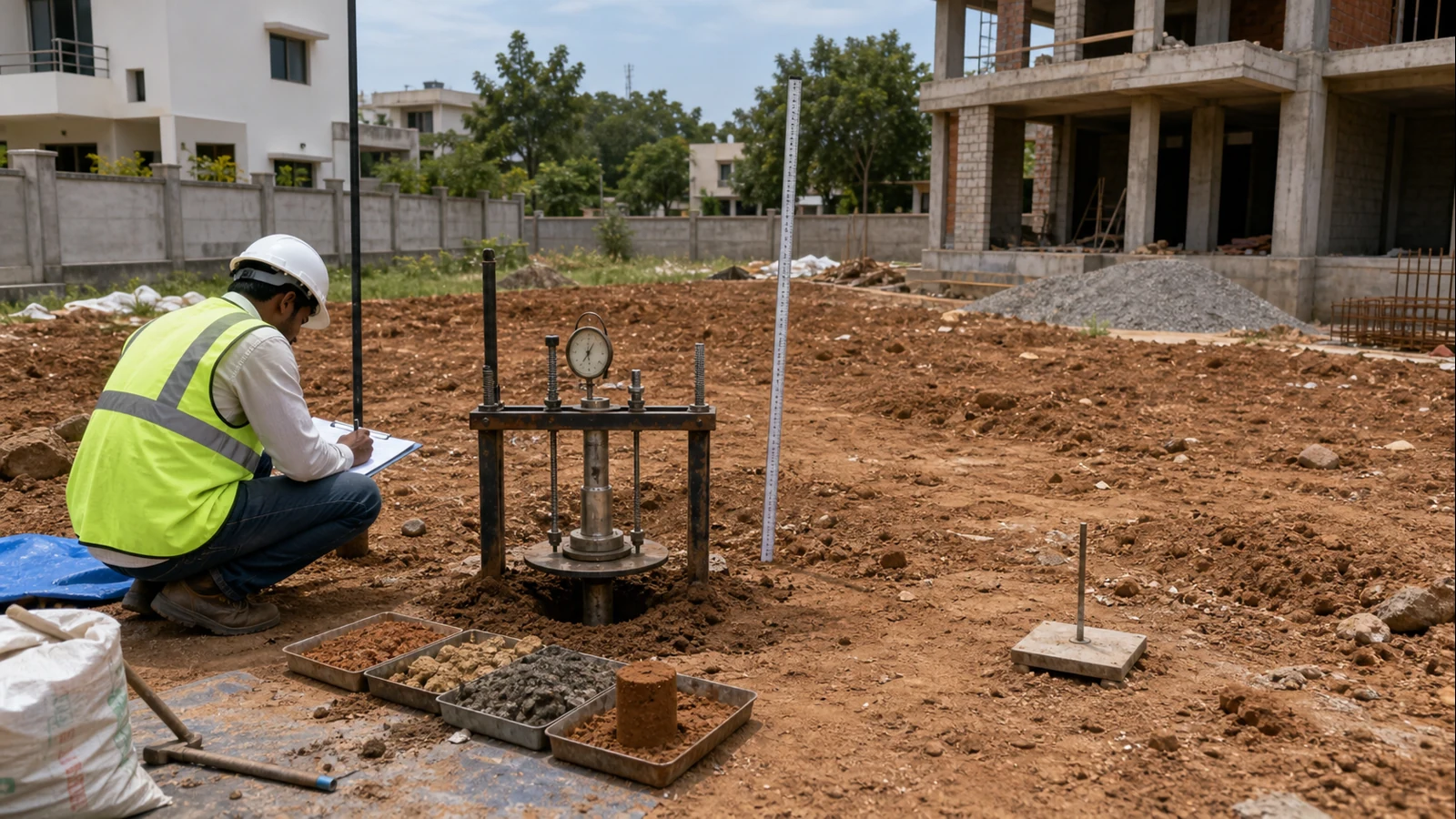
Real Bengaluru case: A 2,400 sq ft villa in Devanahalli developed 12+ visible cracks within 18 months of completion. Investigation revealed the plot had 1.8m of filled soil overlying expansive black cotton. The contractor had designed a standard 4-foot footing. Correct design would have required a raft foundation with piles to rock. Repair cost: ₹9.5 lakhs. Soil test that would have prevented it: ₹12,000.
Mistake #2: Wrong Concrete Mix Ratio (M15 vs M25)
The 1990s shortcut that is still ruining 2026 homes.
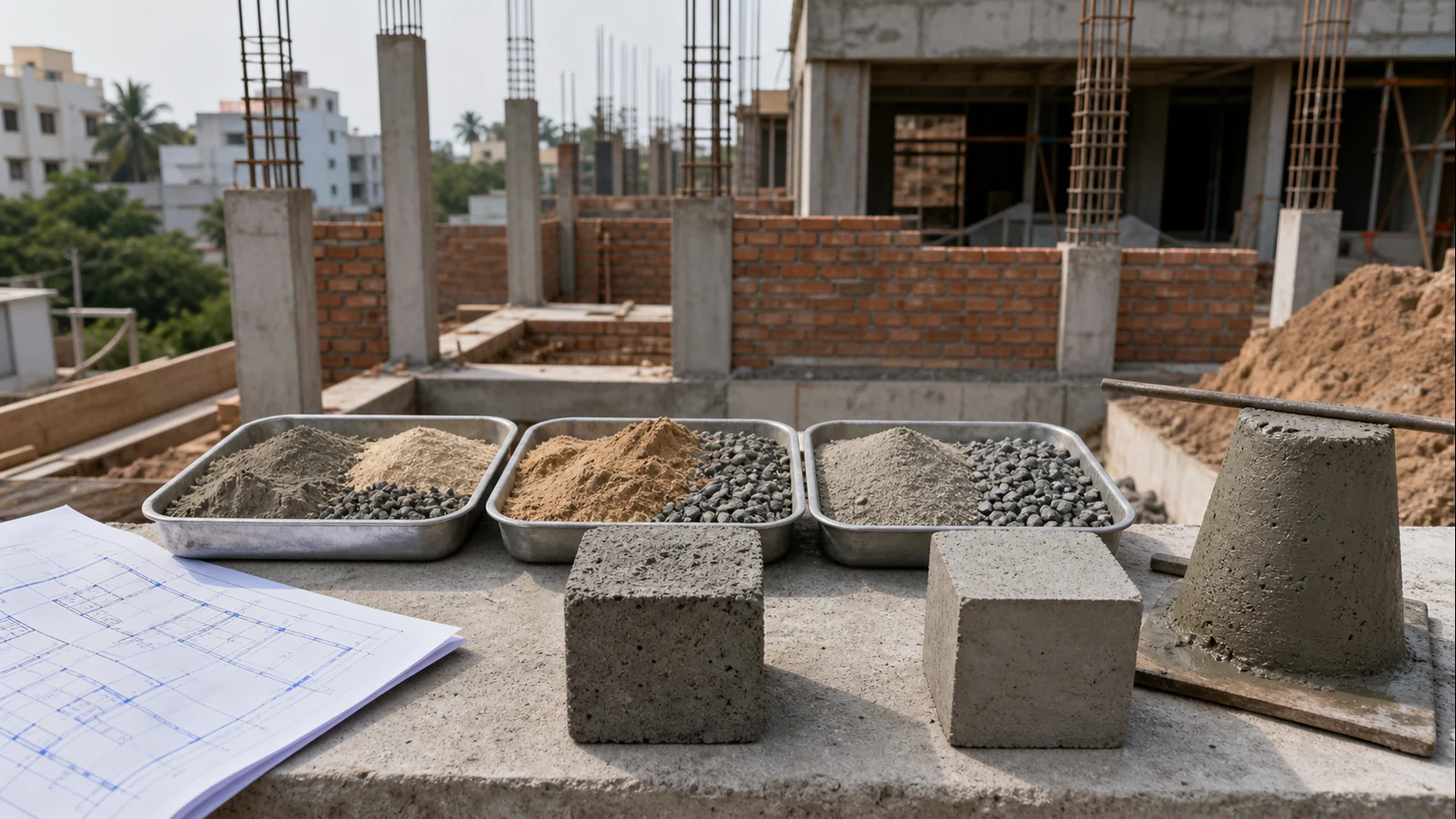
Concrete is rated by grade — M15, M20, M25, M30, M35 — and the grade is determined by the mix ratio of cement, sand, and aggregate. Higher grade = stronger concrete.
| Grade | Mix Ratio (Cement : Sand : Aggregate) | Compressive Strength | 2026 Use Case |
|---|---|---|---|
| M15 | 1 : 2 : 4 | 15 N/mm² | ❌ Never for RCC in 2026 |
| M20 | 1 : 1.5 : 3 | 20 N/mm² | ✅ Footings, plinth beams |
| M25 | 1 : 1 : 2 | 25 N/mm² | ✅ All slabs, beams, columns (recommended) |
| M30+ | Design mix | 30+ N/mm² | ✅ G+3 buildings, commercial |
The dangerous shortcut: Site-mixed concrete in M15 (1:2:4) uses 33% less cement than M25. For a contractor building 4-5 homes per year, this is a saving of ₹60,000-80,000 per project. The cost to you is structural weakness that does not show up for 3-5 years.
The 2026 standard for Bengaluru homes: M25 grade for all RCC slabs, beams, and columns. Footings and plinth beams can be M20. Anything below this is a red flag.
Better still: use Ready-Mix Concrete (RMC) from accredited plants (Ultratech, ACC RMC, RMC India India, Prism Johnson). RMC is mixed at the plant under computer-controlled batching, transported in transit mixers, and poured within 90 minutes. This eliminates the variability of site mixing (where a tired labourer eyeballs the sand and aggregate).
RMC cost in Bengaluru 2026: ₹5,200-6,400 per cubic metre (M25 grade), delivered.
Cost difference between M15 and M25:
- Per cubic metre: ~₹900-1,200 extra for M25
- For a 2,000 sq ft G+1 home (~50 cubic metres of concrete): ₹45,000-60,000 extra for the entire project
- Compared to retrofitting cost: trivial.
Mistake #3: Inadequate Curing (Less Than 14 Days)
The most invisible mistake — and the most preventable.
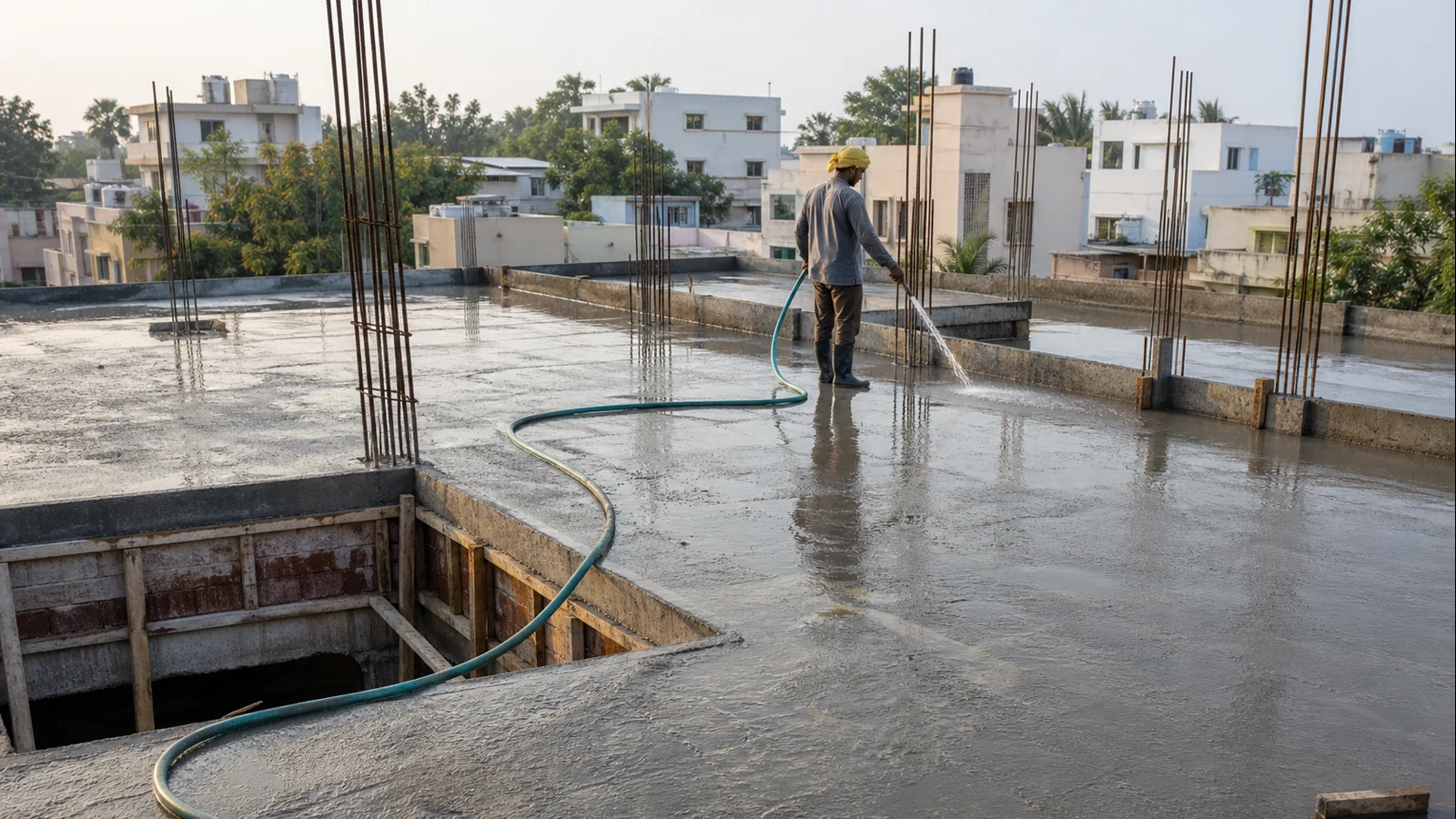
Curing is the process of keeping concrete moist after it is poured, so that the chemical reaction between cement and water (called hydration) can complete properly. Concrete that is not cured does not achieve its design strength.
| Day After Pour | Strength Achieved |
|---|---|
| 3 days | 30% |
| 7 days | 50% |
| 14 days | 70% |
| 28 days | 90% (design strength) |
| 90 days | 100%+ |
The 2026 standard for Bengaluru:
- Slabs: Cure for 14 days minimum, with 2 waterings per day during summer (March-May)
- Columns & beams: 7 days minimum
- Foundations: 3 days minimum
- Monsoon season: Continue curing even if it rains — rain on uncured concrete washes out cement and weakens the surface
The contractor shortcut we see constantly: Curing for 3-4 days and then “moving on” to brickwork. The slab looks fine. The homeowner assumes it is fine. The first monsoon exposes the damage — hairline cracks, water seepage, and the start of structural weakening.
Best practice: ponding for terrace slabs. Build small 50mm-high bunds (mud or sand) around the perimeter of the slab, fill the slab with 25-30mm of water, and let it stand. Top up water daily. This is the gold standard because it ensures 100% of the slab surface stays wet.
Bengaluru climate-specific tip: During March-May, slab surface temperatures hit 55-60°C in afternoon sun. If you water once in the morning and the slab dries out by noon, the curing is essentially useless. Two waterings per day in summer is non-negotiable.
Mistake #4: Using Cheap or Unbranded Cement
Why "any cement" is not the same as "good cement."
Cement is the most counterfeited construction material in India. Bags marked “Ultratech” or “ACC” are routinely refilled with low-grade cement from local plants and sold to unsuspecting homeowners. The price difference is ₹80-150 per bag — for a 2,000 sq ft G+1 home, that’s ₹30,000-50,000 of “savings” the contractor pockets.
The 2026 trusted brands in Bengaluru:
- OPC 53 Grade: Ultratech, ACC, Dalmia, Coromandel, Shree, Ambuja
- PPC (Pozzolana Portland Cement): Same brands, for plaster and brickwork
- PSC (Portland Slag Cement): For foundations and underground work
Cement type by application:
| Application | Recommended Cement | Why |
|---|---|---|
| RCC slabs, beams, columns | OPC 53 | Highest early strength |
| Footings, plinth | OPC 53 or PSC | PSC resists sulphate attack from soil |
| Brickwork | PPC | Better workability, lower heat |
| Plaster (internal) | PPC | Smoother finish |
| Plaster (external) | PPC | Better crack resistance |
Red flags to watch for:
- Cement bags without proper branding, BIS mark, or batch number
- Bags older than 90 days from manufacture (cement loses strength over time)
- “Fly ash substitution” not disclosed in the Bill of Quantities (BoQ) — fine if disclosed, fraud if not
- Cement stored on site in the open, exposed to moisture
Bengaluru-specific note: The humid climate shortens cement’s shelf life. Always check the manufacturing date on the bag (printed on the side). Use bags within 60-90 days in monsoon, 90 days in dry season.
Pro tip: When your contractor orders cement, ask for the delivery challan with batch numbers. Match the batch numbers on the bags at site. If they do not match, refuse delivery.
Mistake #5: Wrong Steel Grade (Fe415 vs Fe550D)
The hidden cost that can compromise your home's safety.
TMT (Thermo-Mechanically Treated) bars come in 4 common grades, and the grade determines the bar’s yield strength — the stress at which the bar permanently deforms.
| Grade | Yield Strength (N/mm²) | 2026 Use Case |
|---|---|---|
| Fe415 | 415 | ⚠️ Stirrups, ancillary work only |
| Fe500 | 500 | ✅ Slabs (residential) |
| Fe500D | 500 (with better ductility) | ✅ Beams, columns (recommended) |
| Fe550D | 550 (high ductility) | ✅ Columns, seismic zones (best for Bengaluru) |
The 2026 standard for Bengaluru: Fe550D for columns, Fe500D for beams, Fe500 for slabs, Fe415 for stirrups.
Why grade matters for Bengaluru: Bengaluru sits in Seismic Zone II (low-to-moderate earthquake risk) per the Indian Standard IS 1893. The “D” suffix in Fe500D and Fe550D means the steel has higher ductility — it can bend significantly before breaking. This ductility is what saves buildings during earthquakes. The cheaper Fe415 has lower ductility and is more likely to snap under seismic stress.
The contractor fraud: Use Fe415 in columns when the drawing specifies Fe550D. The two look identical to an untrained eye. The cost saving to the contractor: ~₹8 per kg. For a 2,000 sq ft G+1 home using 4,000 kg of steel, that’s ₹32,000 of “savings” — at the cost of your family’s safety.
How to verify:
- Every TMT bar has the grade stamped on the rib (e.g., “Fe 550D”). Check 5-10 random bars per delivery.
- The brand embossing must be visible (Tata Tiscon, JSW NeoSteel, SAIL, Jindal Panther, Indus TMT).
- Ask for the Mill Test Certificate (MTC) — a document from the steel plant showing the actual chemical composition and strength of the batch.
Trusted TMT brands in Bengaluru 2026: Tata Tiscon (most premium), JSW NeoSteel, SAIL, Jindal Panther, Indus TMT, Shyam Steel.
Mistake #6: Skipping Waterproofing in Bathrooms and Terraces
Where Bengaluru's monsoons will find every shortcut.
Waterproofing is not optional in Bengaluru. With 5-6 months of monsoon-grade humidity and 2 distinct wet seasons, any waterproofing gap will show up within the first year of occupancy.
The 5 zones that need waterproofing:
- Terrace / roof slab (most critical)
- Bathrooms (especially sunken slabs)
- Water tank (overhead and underground)
- Basement (if applicable)
- Kitchen wet areas (near sink, dishwasher)
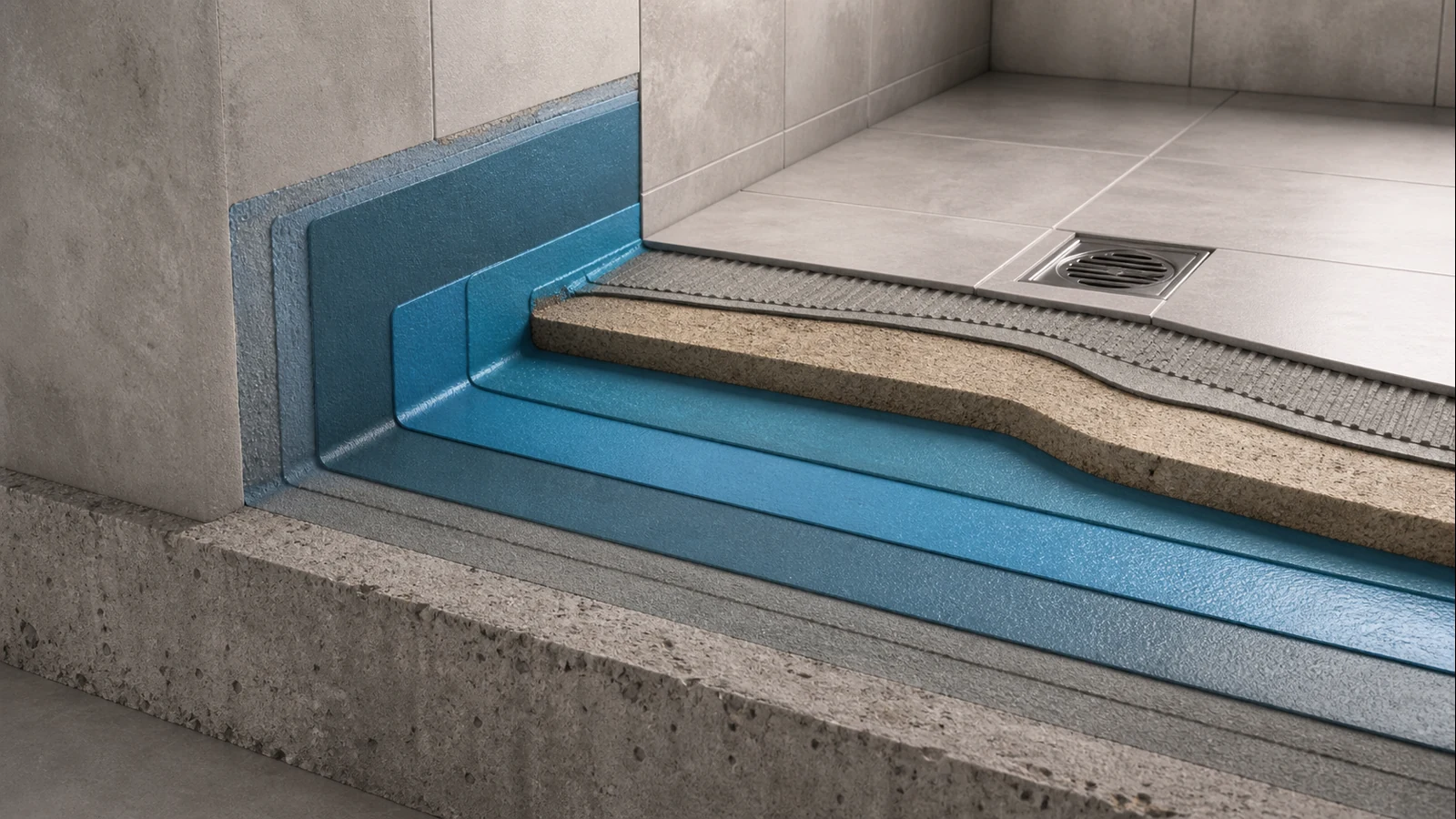
The 2026 standard for bathroom waterproofing (5 layers):
The contractor shortcut: Skipping Layer 4 (the protective plaster) to save ₹8 per sq ft. They tile directly over the membrane. Tile work punctures the membrane. Leakage starts within 6-12 months.
Cost of proper bathroom waterproofing in Bengaluru 2026: ₹45-75 per sq ft (including labour and materials).
Terrace waterproofing options:
| Method | Cost (₹/sq ft) | Durability |
|---|---|---|
| Brickbat Coba (traditional) | 55-80 | 5-7 years |
| Acrylic membrane + protective screed | 75-110 | 8-12 years |
| PU-based torch-on membrane | 110-160 | 12-15 years |
| APP membrane (SBS modified) | 95-140 | 10-12 years |
Bengaluru recommendation: Acrylic membrane + protective screed is the sweet spot for residential. APP membrane for premium builds.
Critical terrace test: After waterproofing is complete, flood the terrace with 50mm of water for 48 hours. Check the ceiling below for any seepage. If you see a damp patch, redo the waterproofing before tiling. This 48-hour test is non-negotiable.
Mistake #7: No Expansion Joints in Long Walls
The mistake that cracks compound walls within one monsoon.
An expansion joint is a 10-20mm gap deliberately left in a long wall (or floor slab) to allow for thermal expansion and contraction. The gap is filled with a flexible material (backer rod + PU sealant or polysulphide sealant).
The 2026 standard: Expansion joints every 6-7 meters in walls longer than 12 meters. Compound walls in Bengaluru layouts are often 15-25m long — they require expansion joints.
What happens without expansion joints:
- Cracks appear at the weakest point of the wall (usually around a column-line joint) within the first hot summer
- Cracks widen over the second monsoon
- Repair is cosmetic only — the structural risk remains
Cost in Bengaluru 2026: ₹150-200 per running foot of expansion joint (material + labour).
The common contractor excuse:
“This is a small compound wall, we don’t need expansion joints.”
The compound wall is exactly where expansion joints are most often skipped, because they are “non-structural.” But the wall still moves with temperature. The cracks do not care whether the wall is structural or not.
Where else you need expansion joints:
- Long balcony parapets (>6m)
- Long sun-shades
- Floor tiles in large living areas (>25 sq m continuous)
- Roof slabs spanning >15m
Mistake #8: Hiring a Mason as Your "Engineer"
The cultural shortcut that fails every modern Bengaluru homeowner.
The most expensive mistake on this list is not a material or a method — it is a decision. And the decision is: “Our mason has 30 years of experience. We don’t need a structural engineer.”
This is the single most common justification we hear from Bengaluru homeowners for skipping professional design. And it is the justification that causes the most structural damage over the long term.
Why the mason-as-engineer approach fails in 2026:
-
Building codes have changed. IS 456 (concrete), IS 800 (steel), and IS 1893 (seismic) have all been updated significantly since the 1990s. A mason’s “30 years of experience” is exactly the problem — it is training in obsolete practices.
-
Soil variability. As discussed in Section 1, Bengaluru’s soil changes every 5-10 km. A mason’s mental model is built on the soil of one area. Move 20 km away and the design rules change.
-
Material evolution. Self-compacting concrete, Fe550D steel, AAC blocks, chemical waterproofing, ready-mix plaster — most of these did not exist when a 30-year-experienced mason started his career. His instinct is to default to what he knows.
-
BBMP compliance. Unengineered homes fail BBMP plan sanction. Insurance claims get rejected. Resale value drops 15-25% when the buyer discovers there are no structural drawings.
The cost of a structural engineer in Bengaluru 2026:
| Building Type | Structural Engineer Fee |
|---|---|
| 30x40 G+1 | ₹30,000 - ₹50,000 |
| 30x40 G+2 | ₹50,000 - ₹75,000 |
| 40x60 G+2 | ₹75,000 - ₹1,10,000 |
| 40x60 G+3 | ₹1,10,000 - ₹1,50,000 |
That is 1.5-2% of construction cost. For a ₹50 lakh build, ₹75,000-1,00,000 is the cost of professional engineering that protects the other ₹49 lakhs.
The math is brutal: Skipping the engineer saves you 1.5-2%. Skipping the engineer and getting the foundation wrong costs you 30-50% of project cost to fix. There is no rational scenario where this trade-off makes sense.
The Liza 270-Point Quality Checklist: At Liza Homes, every project we deliver goes through a 270-point quality checklist that includes all 8 fixes above — and 262 other technical checkpoints across foundation, structure, waterproofing, electrical, plumbing, and finishing. This is the same checklist our internal engineers use to audit contractor work at every stage. You can request a sample of the checklist below.
The Liza Standard: 8-Point Construction Spec at a Glance
For quick reference, here is the 8-point spec we use on every Liza Homes project:
- Soil Test: Geotech report mandatory before design (₹8K-15K)
- Concrete: M25 grade RMC for all RCC (M20 for footings)
- Curing: 14 days for slabs, 7 days for beams/columns
- Cement: OPC 53 branded (Ultratech/ACC/Dalmia) for RCC, PPC for plaster
- Steel: Fe550D for columns, Fe500D for beams, Fe500 for slabs — branded with MTC
- Waterproofing: 5-layer system for bathrooms, acrylic membrane + screed for terraces
- Expansion Joints: Every 6-7m on long walls and parapets
- Engineer Oversight: Structural engineer designs + supervises — not the mason
Why Bengaluru Homes Crack: The Quick Summary
| Mistake | What It Costs to Prevent | What It Costs to Fix |
|---|---|---|
| Skipping soil test | ₹8,000-15,000 | ₹5-15 lakhs |
| Wrong concrete mix (M15 vs M25) | ₹45,000-60,000 | ₹3-8 lakhs |
| Inadequate curing | ₹0 (just time) | ₹2-5 lakhs |
| Cheap / unbranded cement | ₹30,000-50,000 | ₹2-6 lakhs |
| Wrong steel grade | ₹25,000-40,000 | ₹4-12 lakhs (safety risk) |
| Skipped waterproofing | ₹40,000-80,000 | ₹3-7 lakhs |
| No expansion joints | ₹3,000-8,000 | ₹1-3 lakhs (cosmetic only) |
| Mason as engineer | ₹75,000-1,50,000 | ₹10-30+ lakhs |
Total cost to prevent all 8: ~₹2.2-4.5 lakhs on a typical 2,000 sq ft G+1 build Total cost to fix all 8 after handover: ~₹30-86 lakhs — and reduced resale value
Related Reads