
Answer-First Summary
Quick answer
The complete technical guide to building G+3 and G+4 residential structures in Bengaluru. Learn about BBMP height rules, soil testing, column sizes, steel grades, and cost breakdowns for 2026.
- What is the maximum height allowed for a residential building in Bengaluru in 2026? Under the Greater Bengaluru (Amendment) Regulations 2026, the maximum building height for standard residential plots has been increased to 15 metres. This comfortably allows for G+3 or G+4 configurations including stilt parking, provided setback and road-width norms are strictly followed.
- Is a soil test mandatory for a G+3 or G+4 building in Bengaluru? Yes, a soil bearing capacity (SBC) test is highly recommended and practically mandatory for structures exceeding G+2. Multi-story loads require precise calculation of foundation depth and footing type (like isolated, combined, or raft) to prevent structural settlement or cracks.
Architecture & Design - Bengaluru
Building setback calculator
Check setbacks, FAR/FSI cues, height guidance, rainwater harvesting triggers, and a practical approval checklist based on the Bengaluru rules discussed in this guide.
Setback result
Scaled footprint view
Open spaces shown around the buildable zone
Floors & Height Feasibility
Compliance status for different floor counts based on your road width and plot size:
Height & FAR summary
Road-width guidance
Premium FAR & TDR Options
Rainwater harvesting
Why it matters
- Plan recharge elements from the first layout pass.
- Coordinate sump, drainage, and basement zones together.
- Do not treat utility compliance as a post-design add-on.
Approval checklist
- Confirm the authority and rule table before planning the footprint.
- Measure the actual site road width on ground, not only on paper.
- Cross-check Khata, zoning, and buildability before detailed design.
- Verify basement and drainage feasibility before excavation planning.
- Add rainwater harvesting if your plot size triggers the requirement.
Important note
This tool is a planning aid, not a sanction drawing. Irregular plots, road-widening reservations, corner conditions, and local interpretation still need architectural review.
Quick reference - common plot sizes
| Plot | Area (m²) | Front | Rear | Left | Right | FAR | Max cov. |
|---|---|---|---|---|---|---|---|
| 20x30 | 55.74 | 0.75 m | Not req. | 0.60 m | Not req. | 1.75 | 75% |
| 30x40 | 111.48 | 0.90 m | 0.70 m | 0.70 m | Not req. | 1.75 | 75% |
| 40x60 | 222.97 | 12% depth | 8% depth | 8% width | 8% width | 1.75 | 75% |
| 50x80 | 371.61 | 12% depth | 8% depth | 8% width | 8% width | 2.25 | 65% |
Building Vertically in Bengaluru: The G+3 and G+4 Engineering Reality
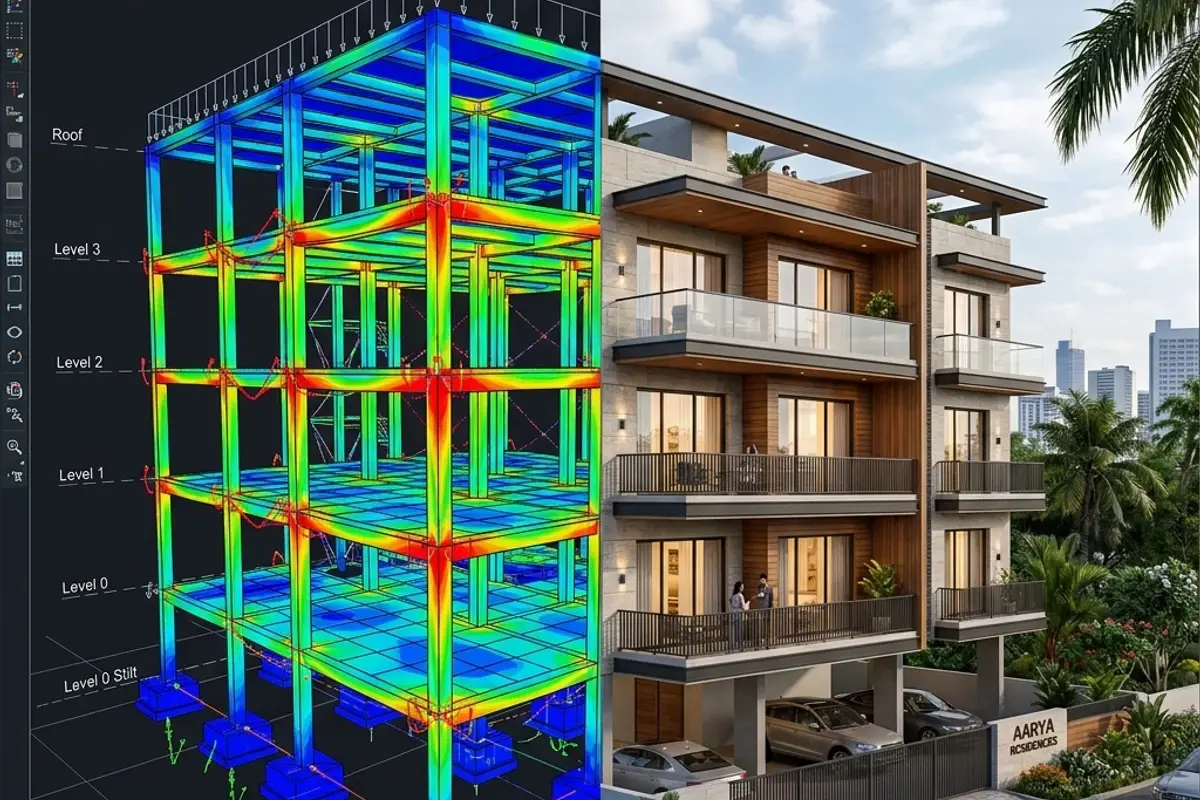
With premium land prices in Bengaluru reaching record highs in 2026, maximizing vertical space is no longer just an option—it is a financial necessity. Plot owners in areas like Sarjapur Road, Whitefield, Hebbal, and JP Nagar are increasingly bypassing standard duplex builds in favor of multi-story structures: G+3 (Ground + 3 Floors) or G+4 (Ground + 4 Floors).
These vertical builds are ideal for multi-generational families or owners seeking passive rental income. However, moving from a simple G+1/G+2 structure to a G+3 or G+4 configuration changes the structural requirements completely. The building is no longer a simple load-bearing frame; it is a complex engineering project subject to strict BBMP bylaws, heavy axial forces, and structural safety challenges.
This comprehensive guide brings you everything you need to know about G+3 and G+4 structural design in Bengaluru for 2026—from legal rules to concrete grades, steel configurations, lift cores, and actual structural construction costs.
📖 Table of Contents
1. BBMP Bylaws & Legal Constraints (2026 Edition)
Understanding height limits, setbacks, and road-width rules.
Before putting pen to paper on your structural drawings, your project must clear the legal hurdles set by the Greater Bengaluru (Amendment) Regulations, 2026.
Maximum Height Limits
- The 15-Metre Rule: The maximum height limit for standard residential buildings on small-to-mid-sized plots has been expanded to 15 metres (up from the earlier 11.5m limit).
- Floor Layout: This 15-metre limit comfortably permits a stilt parking floor plus 4 residential floors (Stilt+G+3 or Stilt+G+4), provided the floor-to-ceiling height of each residential unit is designed at a standard 3 to 3.1 metres (10 feet).
Road Width & Dwelling Unit Caps
Your plot’s location and the road in front of it dictate exactly what you can build:
| Plot Size | Typical Dimensions | Max Kitchens (Dwelling Units) | Minimum Road Width Required |
|---|---|---|---|
| 1,200 sq ft | 30 x 40 ft | 4 Units (e.g., 1 unit per floor) | 9 metres (ideal for apartments) / 6m for self-use |
| 2,400 sq ft | 40 x 60 ft | 6 Units (apartment permission) | 9 metres mandatory |
| 3,875 sq ft | 50 x 80 ft | 8 Units (apartment permission) | 9 metres mandatory |
🛣️ BBMP Road Width vs. Floor Height Visualizer (2026 Rules)
In Bengaluru, the height of your building and the maximum number of floors you can legally construct are strictly limited by the width of the fronting road. If your road is too narrow, you cannot get plan approval for high-rises.
Max Height: 8.0 Metres
Max Height: 11.5 Metres
Max Height: 15.0 Metres
Max Height: 18.0 Metres
🧠 Floor Limit Quick Rule Finder
Select your fronting road size in the dropdown below to check your limit instantly:
Setbacks & Floor Area Ratio (FAR)
- Setbacks: For buildings rising up to 15 metres, BBMP requires mandatory setbacks on all four sides to ensure natural light, ventilation, and emergency access. A typical 30x40 G+3 structure will require a minimum rear/side setback of 1.2 to 1.5 metres, while a 40x60 G+4 building requires up to 2 to 2.4 metres depending on the specific zone.
- FAR Cap & Premium FAR Options: Keep in mind that the base Floor Area Ratio (FAR) remains capped at 1.75 for plots under 360 sq.m (approx 3,875 sq ft). However, under the newly upheld Premium FAR guidelines, you can legally bypass this standard cap if your road width permits:
- On roads $\ge$ 12 metres (40 ft): You can purchase up to 40% Premium FAR (+0.70 FAR, raising the limit to 2.45) at a cost of 50% of the land’s Guidance Value of the notional land area. You can also load up to 20% TDR (+0.35 FAR), enabling a total potential FAR of 2.80.
- On roads 9 to 12 metres (30 to 40 ft): While Premium FAR is not allowed, you can load up to 60% TDR (+1.05 FAR), also enabling a total FAR of 2.80.
- This additional FAR is crucial for G+3 and G+4 structures to legally cover the required built-up space without violating standard municipal zoning limitations. Use our setback calculator on the Revised Setback Rules blog to dynamically estimate your plot’s potential and costs.
💡 Special Rule: How Corner Plots Behave Under BBMP Regulations
If you own a corner site in Bengaluru, BBMP enforces specific bye-laws that can either grant you extra floors or restrict your ground level footprint:
- The "Wider Road" Floor Advantage: If your corner site has roads of different widths on two sides, the permissible vertical height and number of floors (e.g., G+3 or G+4) are determined strictly by the wider of the two roads. This is a massive legal advantage that allows narrow frontage plots to build higher by leveraging the secondary wider road!
- Double Frontage Setbacks: Because a corner plot faces public roads on two boundaries, BBMP treats both of these boundaries as "Frontages". You must leave front setbacks (e.g., 0.90m for small plots under 150 sq.m) on both road-facing sides, rather than just one.
2. Soil Testing & Bengaluru Geology
Why soil bearing capacity (SBC) dictates your foundation depth.
Bengaluru’s subterranean soil profiles are highly diverse. While areas like Indiranagar and Jayanagar are known for stable red loamy soil, peripheral growth corridors like Sarjapur, Varthur, Whitefield, and Electronic City feature extensive clayey soils, loose black cotton soils, and water-logged patches due to historic lake bed topography.
For any building exceeding G+2, Soil Testing (SBC Test) is non-negotiable.
🔍 Typical Soil Test Process for G+3/G+4 in Bengaluru
How SBC Affects Foundation Design:
- High SBC (>200 kN/m²): Common in firm red soil. Allows standard isolated footings at a depth of 5 to 6 feet, saving significant material and labor costs.
- Medium SBC (120 to 180 kN/m²): Standard clayey or sandy loam. Often requires combined footings (where two or more columns share a footing bed) or deeper isolated footings.
- Low SBC (<100 kN/m²): Loose clay, filled-up land, or water-logged areas. Requires a Raft Foundation (a solid reinforced concrete slab covering the entire plot area) or Pile Foundations (driving deep concrete columns down to touch hard rock).
⚠️ Liza Homes Warning: Skipping a soil test for a G+4 build in a clay-rich region like Sarjapur can lead to differential settlement. Over time, the building will tilt slightly, leading to severe diagonal cracks in beams, walls, and structural columns that are extremely expensive to repair.
3. The Concrete Skeleton: Foundations, Beams & Columns
The core structural specifications to handle multi-story loads.
A G+3 or G+4 building carries massive vertical dead loads (concrete slabs, brick walls) and live loads (furniture, residents). The structural frame must transfer these loads seamlessly to the ground.
🏢 The Structural Load-Transfer Pathway
A. Column Sizing & Placements
For a G+1 or G+2 build, standard 9”x12” (230mm x 300mm) columns are sufficient. For a G+3 or G+4 build, columns must be significantly wider, especially on the lower floors:
- G+3 Minimum Column Size: 9” x 18” (230mm x 450mm) or 12” x 12” (300mm x 300mm).
- G+4 Minimum Column Size: 12” x 18” (300mm x 450mm) or 10” x 20” (250mm x 500mm) for the Ground and First-floor columns to prevent buckling under high compressive stress.
B. Concrete Grade Selection (IS 456 Standards)
The strength of your concrete frame depends on the water-cement ratio and exact mixing proportions:
- Footings & Basement Columns: M25 Grade (1 part Cement : 1 part Sand : 2 parts Coarse Aggregate) or M30 Grade for high water-table areas.
- Upper Beams & Slabs: M20 Grade (1 part Cement : 1.5 parts Sand : 3 parts Coarse Aggregate).
- Plinth Beam: Mandatory at ground level, measuring at least 9”x12”, wrapped with high shear reinforcement to tie all columns together and prevent independent settlement.
4. Steel Grades & Reinforcement Ratios
Choosing the right reinforcement bars to resist tensile forces.
While concrete provides high compressive strength, steel rebar provides the tensile strength needed to resist earthquakes, wind forces, and bending moments.
Rebar Grades (TMT Bars)
In 2026, old Fe 415 steel is completely obsolete. For G+3/G+4 structures, always specify:
- Primary Steel: Fe 550 or Fe 550D (D stands for high ductility, offering excellent earthquake resistance). High-grade brands popular in Bangalore include Tata Tiscon, JSW Neo, and A-One Gold.
- Stirrups/Ties: Fe 500 steel of 8mm or 10mm diameter, spaced closely at column-beam junctions where shear stress peaks.
Steel Reinforcement Guidelines (Column Core):
- Minimum Bar Diameter: Vertically running main bars in columns must be at least 16mm in diameter. Never use 12mm bars for columns in a G+3/G+4 configuration.
- Main Bar Configuration: A typical 9”x18” column for a G+3 build will feature at least 6 to 8 bars of 16mm or a mix of 4 bars of 20mm + 4 bars of 16mm.
- Slab Thickness: Slabs must be 125mm to 150mm thick, with double-mesh reinforcement at the edges (cranked bars) to resist negative bending moments.
5. Special Engineering: Lift Cores & Water Sumps
Designing heavy functional elements without compromising stability.
A. The Lift Core (Shear Wall vs. Frame Structure)
Climbing three or four flights of stairs daily is impractical. Modern G+3/G+4 villas almost always feature a 6-passenger home elevator (hydraulic or traction).
🛗 Lift Core Architectures: Concrete Shear Wall vs. Steel Frame
Best For: High load, heavy traction lifts, and overall building stiffness.
- Acts as a primary structural support core
- Excellent acoustic sound dampening
- Highly fire-resistant and permanent
Best For: Panoramic glass elevators, quick modular installations, and compact layouts.
- Visually light and enables 3-side glass views
- Faster construction with less site wet-work
- Requires independent structural isolation checks
- Concrete Shear Wall Core: The gold standard. A 150mm reinforced concrete wall surrounding the lift shaft. It acts as a structural “spine,” adding massive lateral stability to the entire building.
- Steel/Glass Frame Structure: If you are using a glass panoramic lift, you must ensure the structural columns framing the glass shaft are designed to handle both the weight of the lift cabin and the dynamic forces during acceleration and braking.
B. Massive Water Sumps
A multi-unit G+3 or G+4 building needs a massive water storage capacity. A standard 4-family building requires an underground water sump of 12,000 to 18,000 liters (to store municipal water and tanker supplies).
- RCC Construction: Underground sumps must be built using Reinforced Cement Concrete (RCC) with double-mesh steel and waterproof liquid additives. Standard brick masonry sumps are prone to leaking and structural collapse due to lateral soil pressure in high-density areas.
- Placement: The sump should be physically isolated from the building’s main column footings by at least 1.5 metres to prevent water seepage from shifting the soil bearing capacity under adjacent columns.
6. G+3 & G+4 Cost Breakdown (2026 Estimations)
A realistic cost analysis for standard residential builds in Bengaluru.
Building vertically requires additional concrete, heavier steel reinforcement, specialized scaffolding, and additional labor safety measures. Here is a realistic estimation of the structural (Grey Structure) and finishing costs in Bengaluru for 2026.
Architectural & Engineering Fees:
- Architectural Concept & Working Drawings: ₹40 to ₹80 per sq. ft.
- Structural Design & Detailing (with Structural Stability Certificate): ₹18 to ₹30 per sq. ft.
Construction Cost Comparison Table (Based on Plot Sizes):
| Plot Size | Build Config | Total Built-up Area | Grey Structure Cost (Concrete, Steel, Brickwork) | Premium Finishing Cost (Flooring, Woodwork, Bathrooms) | Total Estimated Construction Cost |
|---|---|---|---|---|---|
| 30x40 ft (1,200 sq ft Plot) | Stilt + G+3 Floors | ~4,200 sq. ft. | ₹37 Lakhs – ₹42 Lakhs | ₹45 Lakhs – ₹55 Lakhs | ₹82 Lakhs – ₹97 Lakhs |
| 30x40 ft (1,200 sq ft Plot) | Stilt + G+4 Floors | ~5,000 sq. ft. | ₹46 Lakhs – ₹52 Lakhs | ₹55 Lakhs – ₹68 Lakhs | ₹1.01 Cr – ₹1.20 Cr |
| 40x60 ft (2,400 sq ft Plot) | Stilt + G+3 Floors | ~8,000 sq. ft. | ₹72 Lakhs – ₹82 Lakhs | ₹90 Lakhs – ₹1.10 Cr | ₹1.62 Cr – ₹1.92 Cr |
| 40x60 ft (2,400 sq ft Plot) | Stilt + G+4 Floors | ~9,800 sq. ft. | ₹90 Lakhs – ₹1.02 Cr | ₹1.15 Cr – ₹1.40 Cr | ₹2.05 Cr – ₹2.42 Cr |
Note: Costs are calculated assuming standard premium class specifications in 2026. Sump, borewell drilling, BESCOM commercial/domestic meter licensing, and lifts are calculated extra (~₹10 Lakhs to ₹15 Lakhs depending on selected specifications).
🏗️ G+3 / G+4 Structural Material Estimator (2026)
Estimate the fundamental structural materials required for your multi-story build in Bengaluru.
*Disclaimer: This is an empirical estimation for structural materials (Grey Structure only). Actual structural details must be finalized after analyzing soil test reports and drafting localized column layouts by a certified structural engineer.*
7. Liza Homes Structural Design Checklist
Professional steps for self-builders in Bengaluru.
If you are planning to build a G+3 or G+4 house, carry this checklists to your planning sessions:
Before Construction Starts:
- Run a Soil Test: Never proceed with structural drawings without an SBC report from an accredited lab in Bangalore.
- Verify Road Width: Measure the actual physical road width in front of your plot. BBMP maps often list 30 feet, but actual encroachments might have reduced it to 22 feet, affecting your G+4 apartment permissions.
- Get a licensed Structural Consultant: Do not let local contractors sketch columns on standard paper. Demand certified CAD drawings with bar bending schedules (BBS).
During Structural Work:
- Insist on Concrete Cover Blocks: Ensure cover blocks (40mm for columns, 50mm for footings, 20mm for slabs) are used. This prevents steel from exposing to moisture, avoiding internal rust and structural failures.
- Water Curing (Crucial): Curing of columns and slabs must be maintained for at least 10 to 14 days under Bangalore’s sunny weather to ensure concrete reaches its maximum rated strength.
- Use Mechanical Vibrators: Never let manual laborers compact concrete in column frames. Ensure mechanical needle vibrators are used to eliminate air bubbles and honeycomb voids.
Plan Your Building Within Norms
Liza Homes specializes in building premium, structural-certified custom villas and multi-unit residences in Bengaluru. We manage soil tests, structural architecture, BBMP sanctioning, and turn-key execution.
Launch AI Construction Calculator →Related Reads
- Construction Costs for 30x40 Sites in Bangalore 2026
- Bengaluru Building Rules 2026: Official BBMP Norms
- Is Your Bengaluru Plot Buildable? Crucial Checkpoints
- Setback Rules in Bengaluru: The Complete Guide
Last updated: May 22, 2026. This guide is curated by the Liza Homes Structural Engineering Division based on official BBMP bylaws and IS 456 Structural Concrete codes.