
The Liza Homes false ceiling & cove lighting visualizer is a free, browser-based tool that renders your ceiling before a single GI channel is hung. Choose from six systems — peripheral gypsum tray with cove, floating island on a shadow gap, double-step tray, flat full drop with recessed magnetic track, wooden rafters in a tray, and a slim bedroom perimeter box — then set your real room width, length and slab height. It calculates board area, gypsum sheets, GI channel running feet, cove running feet, downlight count, driver count, finished head height and an indicative Bengaluru budget live, and recolours the whole render as you move the colour temperature from 2200K to 6500K. Nothing is uploaded to a server: every render happens on your own device.
How to Use the False Ceiling & Cove Lighting Visualizer
From a bare RCC slab to a contractor-ready ceiling plan and bill of materials in under three minutes. No login, no watermark to pay for, no 3D software to learn.
Pick the ceiling system
Start with the peripheral gypsum tray if you want the most-built 2026 ceiling, or the floating island if you want one sculptural plane. Each card tells you what it suits, and the work, bedroom and office tabs filter the list to rooms your size.
Enter your real room and slab
Set room width, length and slab-to-slab height in feet, then dial the perimeter band width and the drop. The estimator recalculates board count and shows your finished clear height live, and warns you when the drop pushes it under 7.5 ft.
Set the surface and the light separately
Switch the editing surface between the Ceiling Plane and the Rafters & Reveal so you can build a true dual-tone scheme — smooth white gypsum with teak slats on a matte black recess. Toggle the cove, the downlight grid, the magnetic track and the profile slots, then choose the recess shade.
Compare Kelvin, then export the plan
A ceiling is judged after dark, so slide from 2200K to 6500K before you decide. Flip to the plan view for a dimensioned layout your electrician can set out from, then download the HD render or the specification sheet with quantities.
Types of False Ceilings: Which One Does Your Room Need?
Homeowners usually arrive asking for “a false ceiling” and leave choosing between four genuinely different decisions: how much of the slab to cover, how much height to give up, where the light sits, and what the perimeter box hides.
| Decision Factor | Peripheral Tray + Cove | Floating Island |
|---|---|---|
| Typical Built Cost (Bengaluru, this estimator) | ₹39,500 – ₹64,500 for a 14 × 16 ft living room with a 3000K cove and nine downlights. | ₹33,500 – ₹54,000 for a 13 × 15 ft room with a 10 inch island and six downlights. |
| Height Lost at the Centre | None — the slab stays exposed and flat in the middle. | 9–10 inches across the whole panel area. |
| Hides AC Ducts & Services | Yes, inside the 2 ft perimeter box where ducts normally run. | Only where the island covers them; a duct crossing the centre forces the whole panel down. |
| Slab Height Needed | Works on an 8 ft slab at a 6 inch drop. | Wants 9.5 ft-plus, or the gap reads as a soffit. |
| Maintenance | One driver per 24 Rft of strip, all reachable from the box. | The shadow gap collects dust and needs a pole cloth twice a year. |
| Best For | 2BHK and 3BHK living rooms, and any room with ducted AC. | Great rooms, villa foyers and dining areas with a clean, obstruction-free slab. |
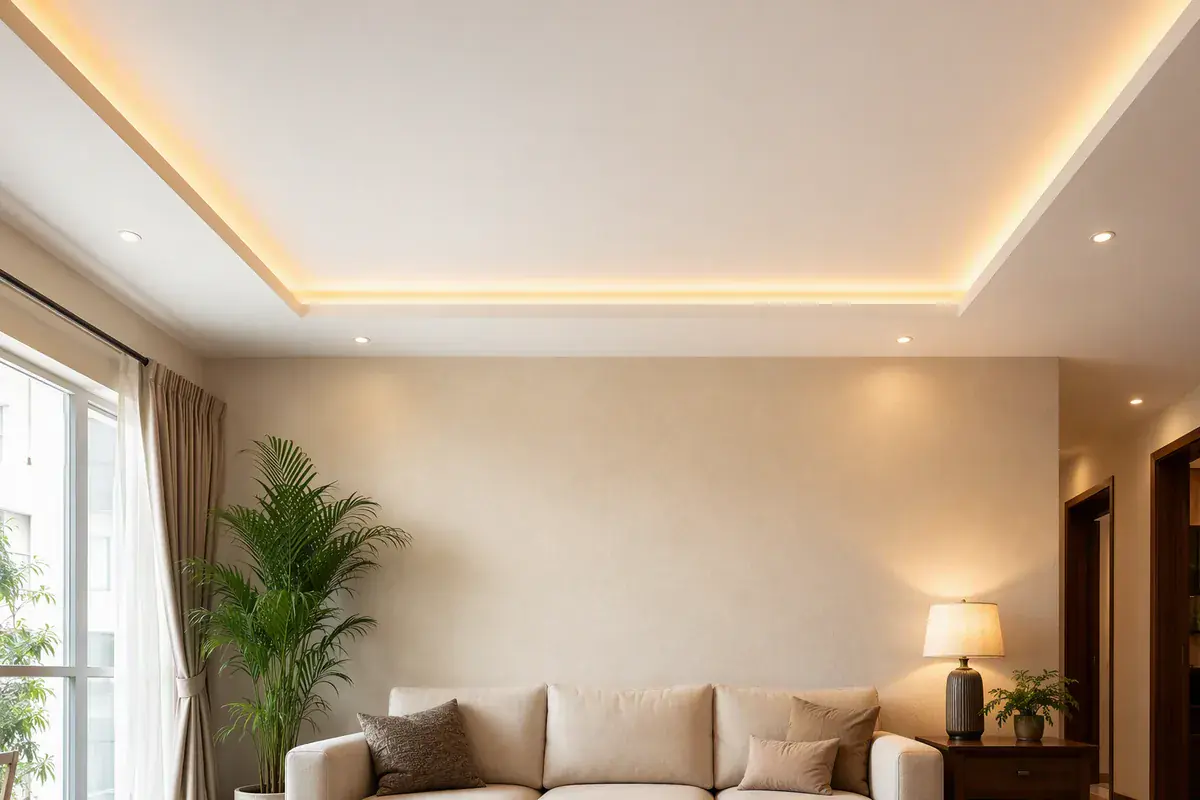
Peripheral Box / Tray
A band of lowered ceiling around the walls with the slab left high in the middle. The cheapest way to hide ducts, conduit and curtain pelmets without losing head height where you walk, and the default Bengaluru ceiling in 2026.
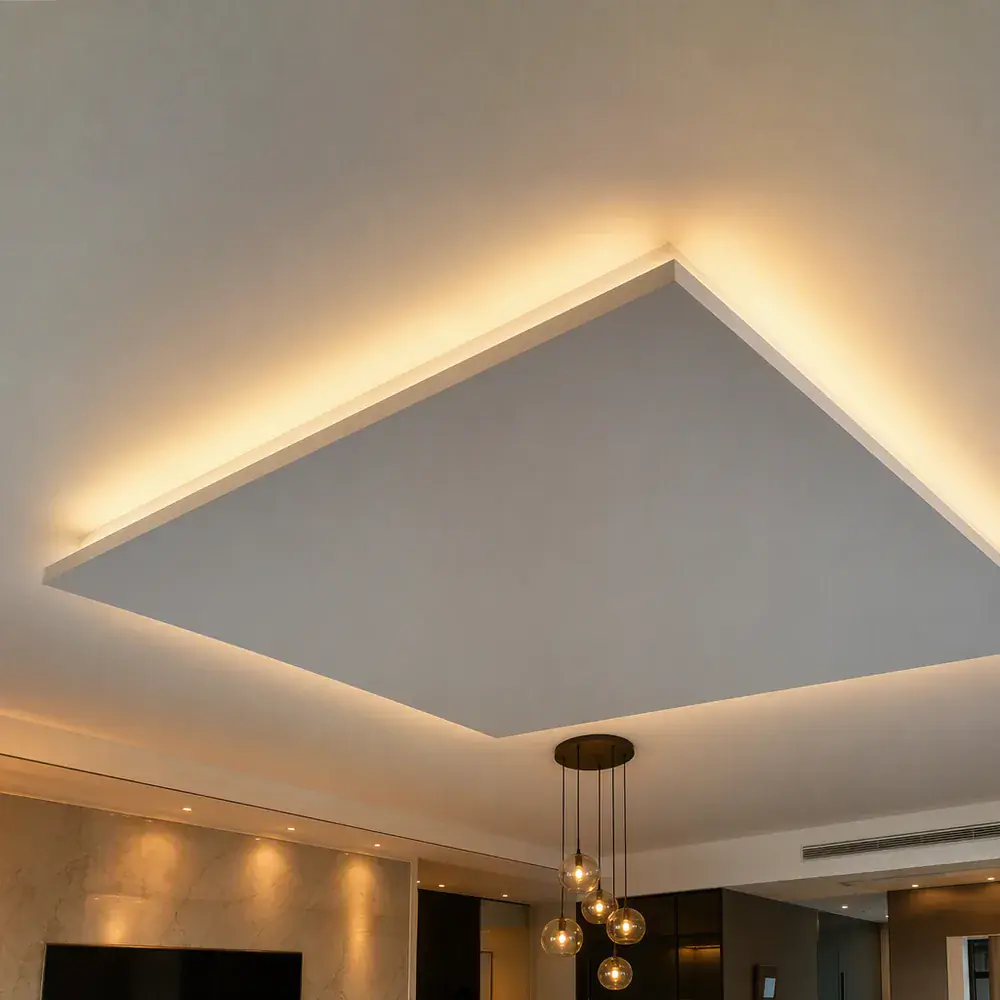
Floating Island
One rectangular plane hung free of the walls with a 40–60 mm shadow gap all round, uplit from a concealed cove. It reads as a designed object rather than a surface, so it needs a clean slab and a room you can see the whole perimeter of.
Double-Step Tray
Two or three stepped collars running up to the slab, each with its own cove. Dramatic and genuinely architectural on a 10 ft slab; on a 9 ft slab the same detail just reads as busy and costs you a foot of air.
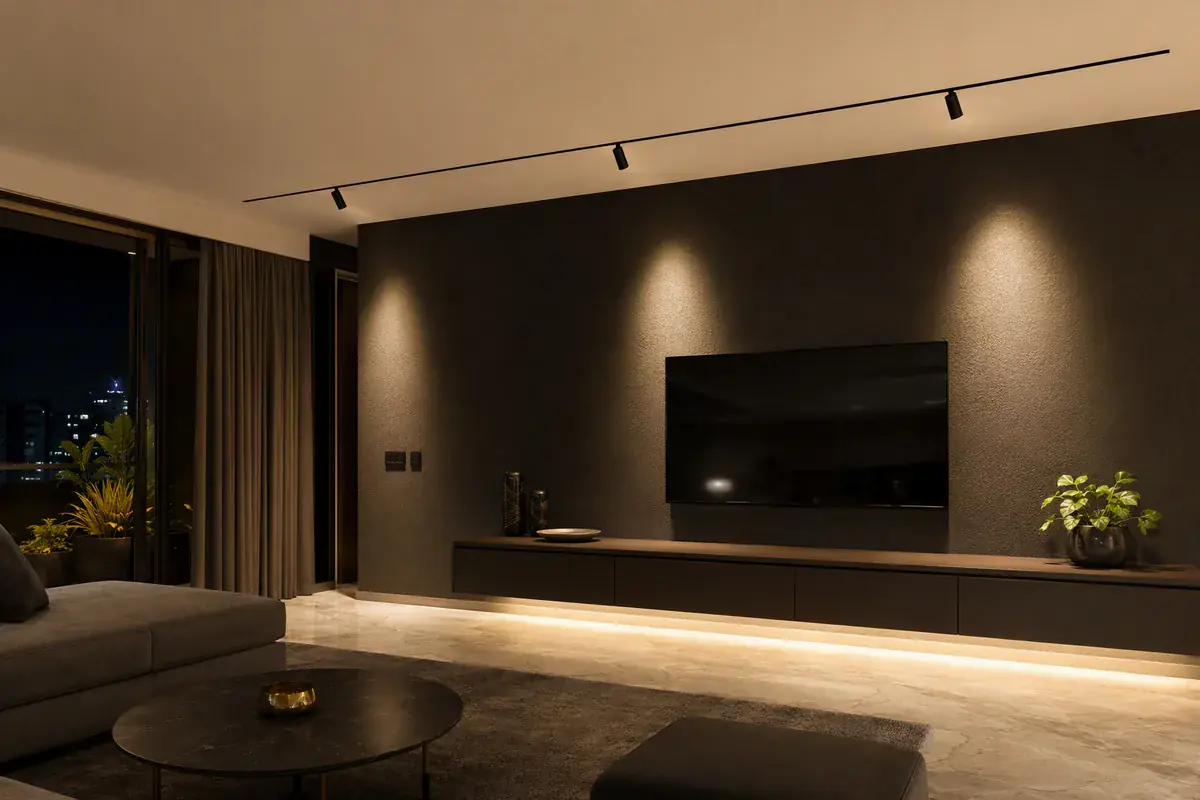
Flat Drop + Magnetic Track
One plane lowered 5–6 inches all over with recessed 48V channels. Nothing decorative, everything serviceable — the right answer for open-plan living, work-from-home walls and anyone who expects to rearrange the furniture.
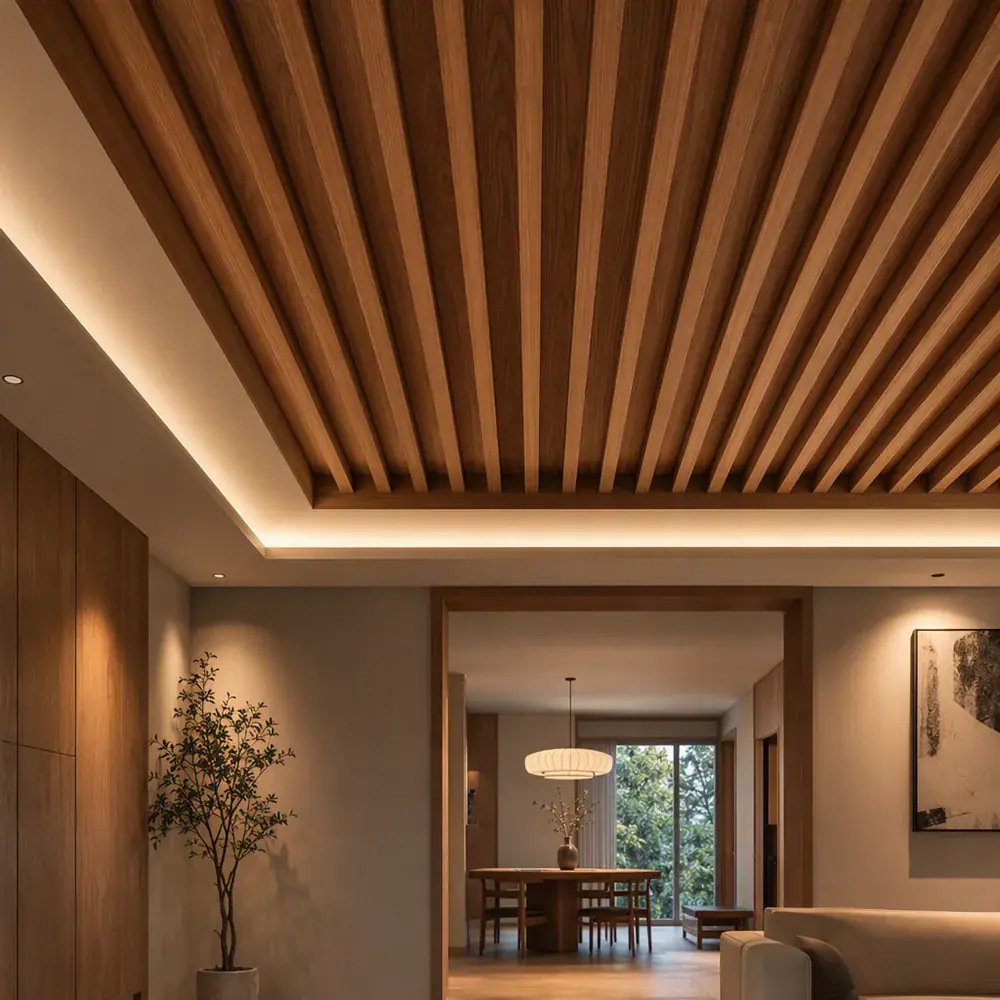
Wooden Rafters in a Tray
Evenly spaced 25 × 50 mm battens on a matte-black backed recess, grazed from the tray rim. Warmth overhead without panelled timber, and the shadow between slats does more for a room than the wood itself.
Bedroom Perimeter Box
A slim 15 inch box with recessed aluminium profile lines and a dimmable warm wash. The cheapest ceiling that changes how a bedroom feels at night, and the one that hides the AC indoor unit and its drain run.
Gypsum vs POP vs Plywood vs Cement Board: Choose the Core First
Four materials cover almost every ceiling built in Karnataka, and the differences are about moisture, movement and how quickly a repair can be made — not about how white the finished plane looks.
| Material | Rate (Installed, Bengaluru) | Works For | Where It Fails |
|---|---|---|---|
| 12.5mm Gypsum on GI frame | ₹95 – ₹130 per sq.ft | Every interior living room, bedroom and passage. Fast, flat, repairable. | Any wet area; the paper face feeds mould if a leak sits for a week. |
| POP (Plaster of Paris) | ₹70 – ₹98 per sq.ft | Curves, arches, cornices and moulded profiles with no visible joint. | Cracks along structural movement joints; 10–14 days of drying time. |
| MR / moisture-resistant gypsum | ₹125 – ₹168 per sq.ft | Ducted AC rooms, attached bathrooms, ground floors with rising damp. | Cost, and it is still not waterproof — a burst pipe ends it either way. |
| 8mm cement board | ₹150 – ₹198 per sq.ft | Balconies, sit-outs, terraces and open porches — fully waterproof and rodent proof. | Heavier, needs a denser frame, and joints telegraph if the substrate flexes. |
| 18mm plywood + laminate | ₹210 – ₹340 per sq.ft | Small feature panels, rafters and louvers that must carry a load. | Warping across a long unsupported span; termite risk on ground floors. |
| Aluminium baffle / clip-in | ₹520 – ₹880 per sq.ft | Kitchens, offices and anywhere you want full demountable access to services. | Cost and an unmistakably commercial look in a home living room. |
The three site details that separate a good ceiling from a bad one
- Frame it, don't pack it. Board must hang on a GI channel frame with hangers at 600 mm centres, never on POP blobs pushed against the slab. Slabs are never level; a 25 mm variance in one corner becomes a visible wave across a 14 ft plane.
- Leave the perimeter free. A 6 mm shadow gap or a flexible mastic joint at the wall is what stops the hairline crack that appears within eight months on a butted, rigid junction.
- Detail the reveal, do not mitre it. External arrises take a metal corner bead. A site-cut 45° mitre on gypsum chips at the first knock and shows as a soft, damaged line for years.
In the visualizer the grain & texture scale slider is the one to use when you are matching a sample: move it until the slat or weave pitch on screen matches what the contractor is quoting, then read the proportion against your room size.
How Much Height Can You Actually Afford to Lose?
This is the decision that goes wrong most often, because nobody measured. The number that matters is not the drop — it is the clear height over the part of the room you stand in.
| Slab-to-Slab Height | Safe Drop | Finished Clear Height | What Fits |
|---|---|---|---|
| 8 ft (2440 mm) | 4 – 6 in, perimeter only | 7 ft 6 in | Conduit, shallow curtain pelmets, slim surface downlights. No ducted AC. |
| 9 ft (2745 mm) | 6 – 8 in | 8 ft 4 in | Split AC drain run, 12W recessed COBs, a single-step tray with cove. |
| 9.5 – 10 ft (2900–3050 mm) | 9 – 12 in | 9 ft 0 in | Ducted AC branches, fire sprinkler drops, double-step tray, magnetic track. |
| 11 ft and above | 12 – 18 in | 10 ft+ | Rafter trays, large floating islands, projector and speaker housings. |
Depth is nearly free; height is not
- On the same 14 × 16 ft room, a 4 inch drop comes out at ₹38,500 – ₹62,500 and a 16 inch drop at ₹41,500 – ₹67,500. You pay about 8 percent more to give up a foot of air, which is why the deep tray that looks right on a 10 ft slab is a mistake on an 8 ft one.
- Measure the lowest obstruction first. Duct, beam, sprinkler main or the AC drain fall. Set the drop to clear it by 25 mm, then keep the box only as wide as it needs to be.
- Do not drop the whole room to hide a 14 inch duct. Run a perimeter box along that one wall instead and keep the centre high.
- Check the door head and the window shutter line. A ceiling that finishes above a door frame but below a pelmet will be argued about for the rest of the project.
- Never go below 7.5 ft clear in a habitable room. It photographs fine and feels claustrophobic in person, especially in Bengaluru where most rooms are already 8 ft.
Cove Strips, Magnetic Track and Downlights: Layer Three Circuits
A ceiling is a lighting fixture before it is a surface. Three separate circuits — ambient cove, task downlight, and accent graze — on three separate switches is what makes a room look designed rather than simply lit.
The cove strip
A 24V COB tape hidden behind a lip, aimed at the slab or the reveal, never at your eye. It gives the whole room its ambient level with zero glare. Budget ₹320 – ₹460 per running foot including the driver, and allow one driver per 24 Rft.
Recessed downlights
12W COB trims on a 4–5 ft grid, set 12–18 inches off the wall so they graze it instead of blowing a hot spot. One per 40–45 sq.ft of floor for general light. Keep them off the cove circuit so you can run the room on cove alone.
Magnetic track
A 48V channel recessed flush into the ceiling with heads that clip in and slide. Re-aim, add or swap spot, flood and pendant heads without cutting the ceiling. ₹420 – ₹720 per running foot plus ₹950 – ₹1,900 per head.
Profile and slot lines
A 10–15 mm aluminium channel with a diffuser, recessed into the box face or the tray rim. It draws the eye along the ceiling line and is the cheapest single element that makes a plain box look intentional.
The dark recess
Paint shadow gaps, rafter backs and slot interiors matte black. A dark recess disappears, so the light and the slats float; a white recess turns every joint into a visible line and kills the contrast you paid for.
Serviceability
Every driver, transformer and track feed is a part that will fail. Put them behind a removable panel or inside the cabinet line, never sealed above a gypsum bulkhead. We have cut open more than one finished ceiling to reach a dead driver.
Use the four lighting buttons above the canvas to test this properly: Daylight for accurate board colour, Warm Cove for the 3000K evening default, Cool White for the 4000K most electricians install by default, and Movie Mode to see exactly where the shadows land with the lamps off. Then flip to the plan view — the dimensioned layout is what your electrician will actually set out from.
Warm vs Cool: What Kelvin Does to the Same Ceiling
Two rooms with identical ceilings, identical boards and identical luminaires can feel completely different, and the whole difference is one number on the box. Drag the Kelvin bar and watch it happen.
| Colour Temperature | Feels Like | Use It In | Avoid It In |
|---|---|---|---|
| 2200 – 2700K | Candle-warm, intimate, strongly yellow | Dining, media rooms, bedroom coves on a dimmer. | Kitchens and studies — it makes food and paper look unclean. |
| 3000K | Warm white, flattering on wood and skin | The safe default for almost every Indian living room and bedroom. | Wardrobe interiors and vanity mirrors, where you want true colour. |
| 3500 – 4000K | Neutral, alert, clean | Kitchen, study, home office, utility and parking. | A living room cove at night, where it reads as an office. |
| 5000 – 6500K | Daylight, blue-white, highest perceived brightness | Store rooms, staircases, exterior and work benches. | Any habitable room — on white gypsum it turns every surface clamshell-blue. |
- Keep every circuit in one room on the same Kelvin. A 3000K cove behind a 6500K downlight grid looks like a wiring mistake, because it is one.
- Buy one reel and one downlight first. Two manufacturers' “3000K” can sit half a bin apart. Test them on the actual ceiling colour before the contractor orders 40 pieces.
- CRI matters as much as Kelvin. Specify CRI 90 or better on any strip that lights wood, skin or food; a cheap CRI 75 tape makes a ₹400 per sq.ft veneer look like laminate.
- Dim-to-warm beats a dimmer on a fixed-Kelvin strip. Ordinary LED dimmers reduce output without changing colour, so a 4000K cove stays 4000K at 10 percent.
False Ceiling & Cove Lighting Cost in Bengaluru (2026)
Lighting drives the number far more than the board does. Here is the same build-up the live estimator uses, so you can sanity-check any quote you receive.
| Cost Component | Rate Basis (Bengaluru) | Share of Total |
|---|---|---|
| Gypsum board + GI framing + finishing | ₹95 – ₹130 per sq.ft installed | 35 – 50% |
| POP ceiling (wet work) | ₹70 – ₹98 per sq.ft | 25 – 40% |
| MR / cement board uplift | ₹125 – ₹198 per sq.ft | +30 – 50% on the board line |
| Wooden rafters / slats on a dark backing | ₹240 – ₹420 per sq.ft of rafter field | 15 – 30% |
| Cove LED (24V COB strip + driver) | ₹320 – ₹460 per running foot | 20 – 35% |
| Recessed 12W COB downlights | ₹650 – ₹1,450 each, fitted | 10 – 20% |
| 48V magnetic track (recessed) | ₹420 – ₹720 per running foot + ₹950 – ₹1,900 per head | 15 – 30% |
| Shadow gap / recess painting | Included in the board line; metal trim ₹170 – ₹265 per Rft | 3 – 7% |
Worked example: the default 14 ft × 16 ft living room peripheral tray
- Slab 9 ft, band 2 ft wide, drop 8 inches. The four perimeter boards total 104 sq.ft of flat surface and the fascia reveals add 22.7 sq.ft, so 126.7 sq.ft of developed board — 5 gypsum sheets with cutting wastage.
- Board and framing → 126.7 sq.ft × ₹95–₹130 = ₹12,000 – ₹16,500, plus 105 Rft of GI channel, perimeter angle, 920 screws, tape and two coats of compound.
- Cove lighting → 32.8 Rft of 24V COB at ₹320–₹460 with 2 drivers = ₹15,300 – ₹25,100. That is more than the entire ceiling build-up.
- Downlights → a 3 × 3 grid of nine 12W COB trims at ₹650–₹1,450 = ₹5,850 – ₹13,050.
- Finishing and overhead → 8–10% for putty, paint, scaffolding and site cleanup.
Load those together and the estimator returns ₹39,500 to ₹64,500 for the room — roughly ₹312 to ₹509 per sq.ft of developed ceiling. Turn the lighting off and the same ceiling is ₹16,500 to ₹24,000. That gap is the single most useful number on this page: in a false ceiling, the lighting is usually more than half the bill.
Swap the perimeter board for teak rafters and the same room crosses ₹55,500 – ₹93,500. Go as far as a bronze mirror inlay and it is ₹73,500 – ₹1,23,500; a demountable aluminium baffle ceiling is ₹84,500 – ₹1,46,500. Scale it up instead of out: a 16 × 18 ft room with the same gypsum tray and lighting lands at ₹44,500 – ₹71,000, and an 18 × 22 ft great room at ₹54,500 – ₹86,500.
| Ceiling (this estimator, default room) | Developed Board | Indicative Range |
|---|---|---|
| Bedroom perimeter box, 12 × 13 ft, MR board | 80.5 sq.ft | ₹34,500 – ₹53,500 |
| Floating island, 13 × 15 ft, gypsum | 107.4 sq.ft | ₹33,500 – ₹54,000 |
| Peripheral tray + cove, 14 × 16 ft, gypsum | 126.7 sq.ft | ₹39,500 – ₹64,500 |
| Peripheral tray, 14 × 16 ft, no lighting | 126.7 sq.ft | ₹16,500 – ₹24,000 |
| Double-step tray, 16 × 18 ft, gypsum | 206.8 sq.ft | ₹53,500 – ₹85,500 |
| Wooden rafter tray, 14 × 16 ft, teak on black | 142.7 sq.ft | ₹55,500 – ₹93,500 |
| Flat full drop + 2 magnetic tracks, 15 × 17 ft | 255 sq.ft | ₹79,000 – ₹1,28,500 |
| Same room with 4 magnetic track runs | 255 sq.ft | ₹1,09,500 – ₹1,81,500 |
Living With a False Ceiling and Its Lighting
A ceiling is the one surface you cannot look at closely, so problems announce themselves late. Six habits keep it clean and serviceable.
- Photograph the ceiling before the board goes on. Once it is closed up, nobody remembers where the hangers, ducts and drains sit. That photo is what stops a drill finding a copper line in year three.
- Mark every driver and hatch on the plan. Keep the drawing the visualizer exports and note where the access panels land; they are the only way to fix a failed driver without demolition.
- Dust cove lips and shadow gaps with a dry microfibre on a pole, quarterly. A cove is a horizontal shelf directly above the brightest light in the room, so every particle shows.
- Never hang anything from a gypsum plane. Board holds about 5 kg per screw; a swing, a projector mount or a heavy curtain pelmet needs to be fixed back to the slab through the ceiling with a drop-in anchor.
- Check for a stain within 48 hours of any leak. A dried, painted-over stain will re-yellow through emulsion within weeks; cut out and re-tape instead.
- Re-tighten rafter and batten fixings annually. Timber moves with the Bengaluru monsoon, and a slat that has started to creak will have opened a visible gap at its fixing by the next summer.
See finished ceilings across Bengaluru homes in our design gallery, or price the whole project — ceiling, joinery and finishes together — with our interior cost calculator. If you are building rather than fitting out, our house construction calculator includes a dedicated false ceiling estimator.
False Ceiling & Cove Lighting Visualizer FAQs
The questions Bengaluru homeowners ask most before they close up a ceiling.
What is a false ceiling and cove lighting visualizer?
It is a free browser tool that renders your ceiling before the first GI channel is hung. You pick a ceiling system, set your real room width, length and slab height, choose the board finish, the cove, the downlights and the colour temperature, and instantly see the result plus a material list and an indicative Bengaluru cost, all without uploading a single photo to a server.
How much does a false ceiling cost in Bangalore in 2026?
The board and framing work runs at ₹95 to ₹130 per sq.ft for standard gypsum, ₹70 to ₹98 for POP, ₹125 to ₹168 for moisture-resistant board and ₹150 to ₹198 for cement board. A 14 ft × 16 ft living room peripheral tray with a 3000K cove and nine recessed downlights comes out at ₹39,500 to ₹64,500. Strip the lighting back out and the same ceiling is ₹16,500 to ₹24,000, which tells you that in a false ceiling the lighting is usually half the bill.
How much height does a false ceiling lose?
A peripheral gypsum box needs 6 to 8 inches, a floating island 9 to 10 inches, and a double-step tray up to 12 inches. The catch is that depth barely changes the price: on the same 14 × 16 ft room a 4-inch drop costs about ₹38,500 to ₹62,500 and a 16-inch drop about ₹41,500 to ₹67,500, so you are paying only around 8 percent more to give up a foot of head height. Below a 9 ft slab we keep the drop at 6 inches or less and never design below 7.5 ft of clear height.
Is gypsum better than POP for a false ceiling?
Gypsum wins on speed, consistency and repairability: boards are screw-fixed to a GI frame in two or three days, joints are taped, and a damaged section cuts out and re-tapes. POP is cheaper and the only way to get a truly curved or moulded profile, but it is wet work that takes one to two weeks to dry and cracks along structural movement joints. In Bengaluru we use gypsum for the plane and POP only for cornices and arches.
What colour temperature is best for cove lighting?
3000K is the safe default for Indian living rooms and bedrooms: it flatters wood, skin and warm whites, and it reads as designed rather than as an office. Use 2700K in a dining or media room and 3500 to 4000K in a kitchen, study or home office where you actually work. Avoid 6500K anywhere except a parking or utility ceiling; on white gypsum it turns every surface clamshell-blue. Slide the Kelvin bar in the visualizer to see the same tray at 2200K and 6500K before you buy a single reel.
How many recessed downlights do I need?
Allow one 12W COB downlight per 40 to 45 sq.ft of floor for general room light, spaced 4 to 5 ft apart on a grid and 12 to 18 inches in from the wall so they graze it instead of throwing a hot spot. A 14 × 16 ft living room therefore needs about five to seven downlights plus the cove, not the twelve to fifteen most site electricians install by default. More lights rarely means better light; it means more ceiling full of holes and a higher driver count.
What is a magnetic track ceiling light?
A 48V aluminium channel recessed flush into the ceiling with small luminaires that clip in and slide along it. You can move, add or swap spot, flood and pendant heads without cutting the ceiling or rewiring, which is why it has replaced fixed downlights in most 2026 living rooms. Budget ₹420 to ₹720 per running foot for the recessed track and feed rails plus ₹950 to ₹1,900 per head, and always put the driver somewhere serviceable.
Should the ceiling recess be painted black?
Yes for shadow gaps, rafters and linear slots: a matte black or charcoal recess disappears, so the slats and the light read as floating. A white reveal does the opposite and turns every joint into a visible line. The one exception is a shallow cove under 4 inches deep, where a white reveal throws noticeably more light into the room. Pick between matte black, charcoal, warm white and brass-lined in the tool and compare them at 2700K.
Can I put a false ceiling over an AC duct or a beam?
Yes, and that is most of why people install one. Measure the lowest obstruction first — duct or beam — then set your drop to clear it by 25 mm and hang the perimeter box around it so the flat centre stays as high as possible. Never screw board directly to a duct; frame it with an angle. Keep a 450 × 450 mm access hatch above every fan coil, damper and driver, and put the hatch in the cabinet line rather than in the middle of a cove.
Do wooden rafters in a ceiling get hot or collect dust?
Both, so detail for it. Use 25 × 50 mm battens with a 25 to 50 mm gap so air moves across them, keep the backing painted dark so the shadow does the work, and never install solid timber against an uninsulated slab where condensation forms in April. Dust with a dry microfibre on a pole every month; a wet cloth swells the batten edges. In the visualizer, set slat width and gap until the rhythm matches the sample you are being quoted.
Get This Ceiling Built in Bengaluru
Export your render, ceiling plan and specification sheet, then send them to the Liza Homes design team for accurate GI framing, serviceable drivers and moisture-correct boards. Or price your full home interior in 60 seconds.